
More valuable than gold, oil, or even ever-elusive attention… the world’s most valuable resource is now trust.
The internet is now so big and so filled with complete and utter garbage that the first question we ask when we encounter someone or something new is simple: Can I trust this?
If you can’t build trust either for yourself or for your organization, you’ll quickly find yourself relegated to the scrap heap of irrelevance.
Trust is the difference between someone hearing you and someone listening to you. It’s the prerequisite for conversion. Its absence is the single greatest roadblock to action from your intended audience. You can intrigue someone, but if they don’t trust you they will likely never take that next step.
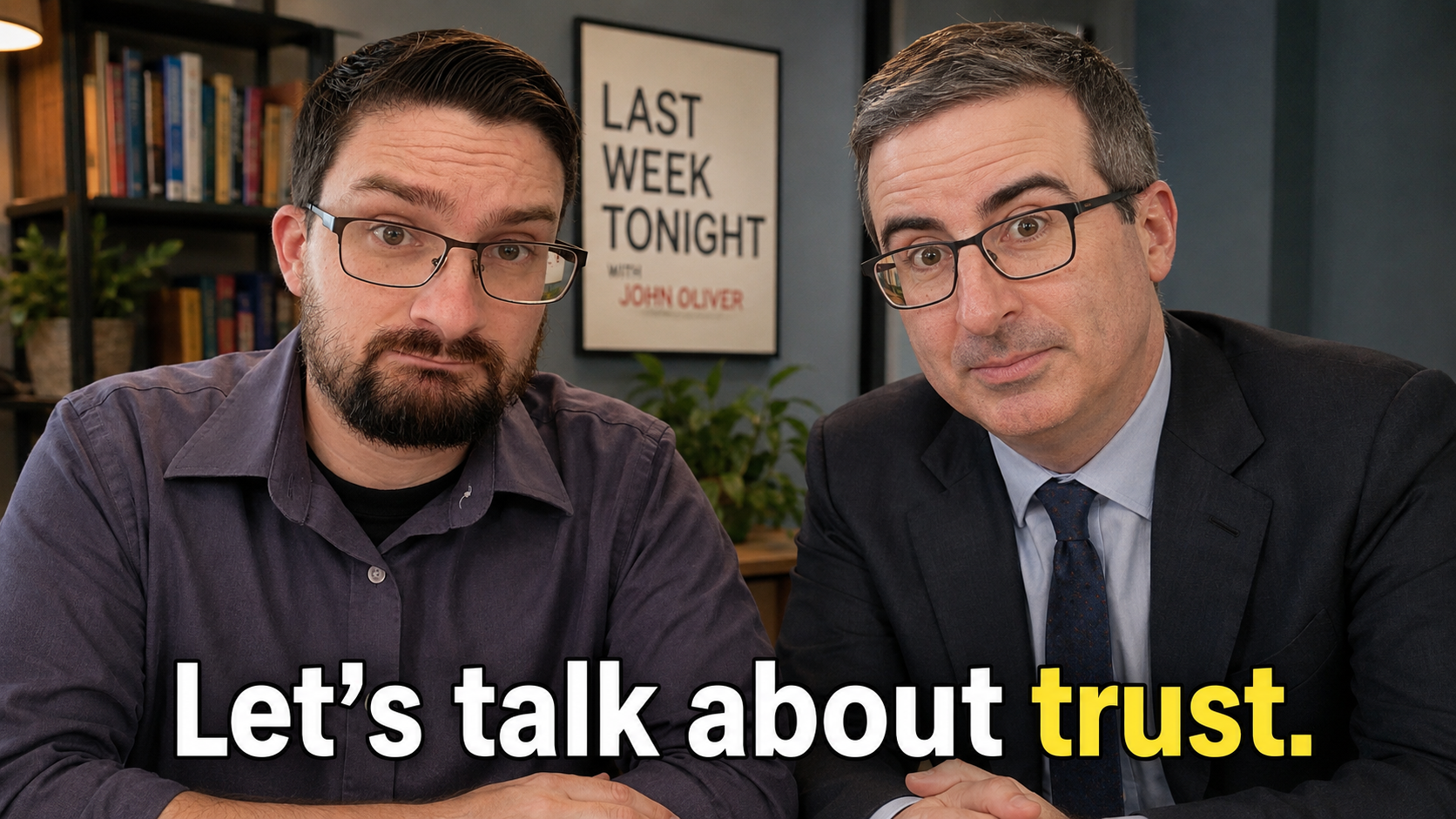
(Putting on my best John Oliver impression)
So tonight let’s look at trust: why it’s valuable, and how transparency, personality, and human connection are imperative ingredients in building trust.
WWW… The Wild Wild Web
The internet is an incredible place. No threshold for “publishing” means that anyone with a connection can “publish” anything.
This has led to tremendous democratization, both politically and economically. It has also led to a tremendous increase in the amount of utter crap on the internet.
Did you know that 90% of the entire internet is porn?
If you didn’t know that, but believe it’s probably true… hold on to that thought for a moment.
If you thought, “There’s no way that could possibly be true”... good for you.
That “statistic” actually came from a discussion on Reddit in 2018.
In 2016, Psychology Today cited the internet as being about 30% porn… not 90%.
In 2019, Statista reported on two studies that found that 4% of websites are porn but 13% of all web searches and 20% of all mobile searches are for porn.
Still not 90%.
Why are we talking about this? Because 83% of all statistics are made up on the spot (including that one). But as many people have discovered, if you say something with enough conviction, people will believe you.
Every day, it feels like more and more of the internet is made up of lies, scams, and fake crap. But now it’s also made up of lies, scams, fake crap, AND AI lies, AI scams, and AI fake crap (aka AI slop).
Believe it or not, I couldn’t actually get John Oliver to pose with me for the image for this post. I hope this post is not crap (I personally write every post), but that image totally is.
Finding a good image for heavily conceptual blog posts is always tough, and sometimes I use AI. This option was just too funny not to use. The totally unrealized, eerie similarities in appearance? Well that’s why I don’t shave my beard…
Do I really have to say this? Transparency is important.
If your only goal is financial profit, you can probably stop reading right here. There are literally countless ways to make money by lying, cheating, and scamming people.
But for those of us interested in making the world a better place not just for ourselves but for others as well, trust is the most valuable commodity we could ever possess. And transparency is a huge part of building trust.
When people encounter you (or your brand) online, if they have that healthy sense of skepticism that is vital to survival these days, they’re going to try to figure out what is motivating you to do the things you do.
Sometimes our motivations are pretty self-evident. Other times, not so much. We can start the process of building trust by simply being transparent from the outset.
My website explains what I do, how I came to do it, and why I’m doing it.
I state pretty clearly that I got tired of doing marketing for retail and corporate industries and found a passion for working with nonprofits, artists, faith-based organizations… people I connected with and found their work interesting.
I also have a Values page that lays out the principles I try to follow. The idea is that anyone who wants to work with me can get a quick sense of who I am and what I’m about.
It’s not exhaustive by any means, but it should help make my motivations clear from the outset.
Not-so-hidden motivations: Money
I worry about kids growing up today surrounded by our influencer economy on social media. These influencers make money by keeping their audiences following along and engaged.
What goes unsaid is that many of these influencers have realized that the more extreme the things they say and do, the more they hold people’s attention.
They may not (re: often don’t) believe what they’re saying, but they have a financial incentive to say whatever will keep people reacting, clicking, sharing and commenting.
Money is a pretty obvious motivator, but if you don’t know how that money is made or where it’s coming from you can fall victim to some pretty bad influences.
And that’s why it’s so important to be able to figure out who someone is and whether you can trust them.
A not-so-secret ingredient: Personality
I think that, increasingly, personality is the not-so-secret ingredient in building trust. I think this because your personality instantly humanizes you in a way that can help build trust.
AI may be able to be trained to imitate my writing style, but it won’t reproduce my stream-of-thought narratives.
It can’t reproduce my exact nerdiness; can’t quote my favorite lines from The Office, or decide to make a John Oliver reference in the intro because that’s what I watched last night while brainstorming this post. It can’t be a relentless oversharer like I am because it’s not me.
My weirdness is a weapon against imitation. My particular nerdiness is something unique to me. When you read this blog you may question my sanity, but you hopefully never question whether I’m real or not.
Put another way… be real, be weird, be whatever comes to your mind.
It’s all about human connection
The last point about personality is really just an element of one fundamental truth: trust is all about human connection.
On so many levels, trust is personal.
It’s personal because it is something we can and must decide for ourselves. I cannot choose whether you trust me or not. Only you can choose to trust something or someone.
Much as I love data, analytics, spreadsheets, and piles of numbers, these things are abstractions of the real-life stories they try to represent. But they are also all too easily manipulated, spun, or straight-up fabricated.
Distrust at scale
Our younger generations are growing up (ideally… hopefully?) questioning what they see online, knowing how easily it can be made up. But they also question institutions that exist in the real world.
In the U.S., faith in large societal institutions is at an all-time low. Government, religion, local politics, education and nearly every other fixture in our culture now face audiences whose faith has been shaken. Many people approach them with a questioning eye, if not outright distrust.
So how do large institutions build trust? Not by drowning their audiences in data (much as I wish that worked) but by telling people stories.
Stories help people make sense of their world. Stories help people make sense of what would otherwise just be numbers on a page (data).
People connect with people’s stories because they understand them and the stories engage their emotions. It’s great to be able to say we raised a bunch of money for people in need. It’s far more compelling to be able to illustrate what that help looks like and the impact it has on a real person’s life.
So building trust is easy, right?
If this fascinating 1,200-ish word post made you think that building trust is easy… I’m sorry. It’s not.
Building trust is a practice of active verbs. Working. Thinking. Writing. Showing up.
I write this blog because it helps establish my credibility. It shows how I think and helps me hone my writing, my communicating, my arguments. It also takes time and effort.
And here’s where it feels tough: building trust requires some altruistic investment. You are going to have to give away something of value to build trust.
When you publish your writing without gatekeeping it, i.e., selling your content for money or information (aka marketing leads), you are giving away your time, effort, and expertise. But what you are gaining, what you are building, is a baseline of credibility.
So keep working. Keep thinking. Keep giving away gem-like nuggets of your creative weirdness.